
Introduction
A door is more than a panel mounted within a frame. Its performance depends on several hardware components working together correctly. Handles, locks, hinges, cylinders, closers, and other accessories each perform a specific function. Therefore, selecting them as a coordinated set is essential for reliable operation, consistent appearance, and long-term value.
For architects, interior designers, builders, and homeowners searching for the Best Door Hardware in India, understanding how these components work together can prevent compatibility problems and unnecessary replacement costs.
AceLine provides a broad range of architectural hardware designed for residential and commercial applications, making coordinated hardware selection easier for different project requirements.
What Is a Door Hardware Set?
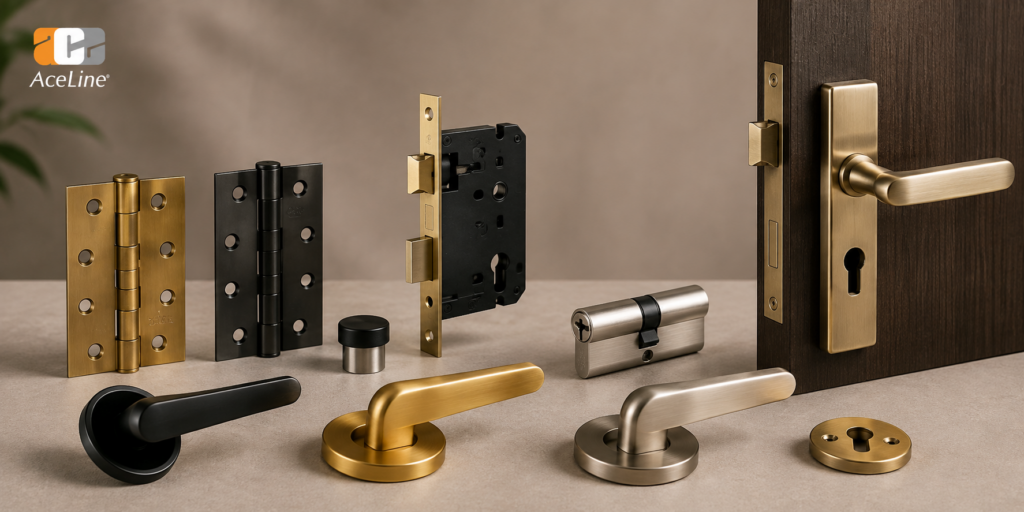
A door hardware set is a combination of components specified for one door application. The exact combination depends on the door type, location, usage, security requirements, and design.
A typical set may include:
- Door handle or pull handle
- Mortise lock or other locking mechanism
- Cylinder and keys
- Door hinges
- Door stopper
- Door closer, where required
- Tower bolt or flush bolt for suitable applications
- Other installation accessories
Not every door needs every component. Instead, the objective is to specify the right combination for the particular door.
1. Door Handles and Locks Should Be Specified Together
The handle and lock are among the most important components of a hardware set. Their compatibility affects installation, operation, and overall appearance.
Lever handles are commonly paired with mortise locks on suitable doors. When selecting them, check the lock body dimensions, spindle requirements, door thickness, back set, and handle configuration.
AceLine offers a range of lever handles in different designs and finishes, allowing project teams to coordinate functionality with interior aesthetics.
For entrance applications, larger pull handles can create a distinctive architectural statement. AceLine brass pull handle collection includes multiple designs and finishes for different door styles.
2. Hinges Must Match the Door and Hardware Specification
Hinges carry the door’s weight and allow it to open and close smoothly. Consequently, hinge selection should never be treated as an afterthought.
Consider:
- Door weight
- Door dimensions
- Frequency of use
- Hinge size
- Material
- Finish
- Bearing configuration
For example, a heavier door may require a different hinge specification from a lightweight internal door.
AceLine door hinge range includes solid brass and ball-bearing options, providing choices for different residential and architectural applications.
3. Cylinders and Locking Components Need Compatibility
A locking system is only effective when its individual components are compatible.
When specifying a cylinder, consider the lock type, door construction, required keying arrangement, and intended application. The cylinder should correspond with the selected lock rather than being purchased independently without checking compatibility.
AceLine hardware collections include locking products designed for different door applications, helping project teams build a more coordinated specification.
4. Door Closers Should Be Considered for Appropriate Applications
Some doors require controlled closing for practical, safety, or building-management reasons. A door closer regulates the closing movement and helps prevent doors from remaining unintentionally open.
However, a closer should be selected according to the door’s size, weight, usage, and installation conditions.
AceLine hardware portfolio includes door control products, giving designers and project teams another component to consider when developing a complete door specification.
5. Door Stoppers Protect Both Door and Surrounding Surfaces
A door stopper can prevent excessive opening and reduce the risk of the door or handle striking a wall or nearby surface.
Although relatively small, this component can contribute to protecting expensive interior finishes.
For premium residential projects, AceLine door accessories can be coordinated with the selected handles and other hardware to maintain a consistent finish throughout the space.
6. Finish Consistency Matters across the Complete Set
Functionality is only half of a successful hardware specification. The visual relationship between components matters as well.
A door with a brass lever handle, contrasting hinge, unrelated lock trim, and different-finish stopper can appear inconsistent.
Therefore, specify finishes across the complete hardware set wherever practical.
Popular options include brass, antique finishes, satin finishes, nickel, black, and other surface treatments. AceLine offers multiple finish choices across its hardware portfolio, helping designers create a coordinated appearance.
7. Consider the Door’s Actual Application
The Best Door Hardware Sets are not necessarily the most expensive sets. They are the ones correctly matched to the door and its environment.
A bedroom door, main entrance, office door, bathroom door, and high-traffic commercial door can have very different requirements.
Before finalizing the specification, identify:
- Door material
- Door thickness
- Door size and weight
- Traffic level
- Security requirements
- Environmental conditions
- Required finish
- Installation method
This approach helps avoid selecting products based purely on appearance.
Why a Coordinated Specification Is Better
Specifying compatible components together offers several practical advantages.
First, it reduces the possibility of installation problems. Second, it creates a consistent appearance across the project. Third, it makes procurement and replacement easier because the required components are clearly documented.
For architects and builders looking for the Best hardware in Uttar Pradesh, the same principle applies: select hardware according to project requirements rather than relying only on price or appearance.
AceLine supports this approach through a broad portfolio covering handles, locks, hinges, pull handles, and related architectural hardware.
How to Create a Better Hardware Schedule
For larger projects, create a hardware schedule before procurement begins.
Record details such as:
- Door identification
- Door location
- Door type
- Handle type
- Lock type
- Hinge specification
- Finish
- Closer requirement
- Accessories
- Quantity
A clear schedule allows architects, contractors, suppliers, and installation teams to work from the same specification.
AceLine can be considered when developing coordinated specifications for projects requiring consistent architectural hardware across multiple doors and spaces.
Conclusion
Understanding how door hardware components work together is essential when specifying reliable and visually consistent door systems. Handles, locks, cylinders, hinges, closers, and accessories should be selected according to the door’s construction, application, usage, and design requirements.
For anyone searching for the Best Door Hardware in India, the right approach is not simply to choose individual products. Instead, create a complete and compatible specification in which every component performs its intended role.
AceLine range of architectural hardware provides options for different residential and commercial applications, helping project professionals combine performance, durability, and coordinated design.
FAQs
1. What components are normally included in a door hardware set?
A typical set can include a handle, lock, cylinder, hinges, stopper, and, where appropriate, a door closer or additional accessories. The exact combination depends on the door and its application.
2. Should door handles and locks be selected together?
Yes. Handle and lock specifications should be checked for compatibility, including spindle dimensions, lock configuration, door thickness, and back set.
3. How do I choose the right hinges for a door?
Consider the door’s weight, dimensions, frequency of use, material, hinge size, and required performance before selecting the hinge.
4. Why is finish consistency important in a hardware set?
Coordinated finishes create a more cohesive appearance and help the hardware complement the overall interior or architectural design.
5. What should I consider when selecting the best door hardware sets? Consider the door construction, dimensions, usage, security requirements, environmental conditions, compatibility between components, finish, installation requirements, and long-term service needs.